
Friday, 4 September 2020

Commenting Thread
A comment thread is a continuous conversation that uses the comment function. A comment thread consists of a greeting, positive feedback and an open question. Open questions are used to continue the conversation.
I started a comment thread on Te Raumati's blogpost about the Gruffalo Character Descriptions. She explained that her task was to create a character description that tells about the appearence, personality and experiences of a character.
LI: to use open questions in a comment thread.

I started a comment thread on Te Raumati's blogpost about the Gruffalo Character Descriptions. She explained that her task was to create a character description that tells about the appearence, personality and experiences of a character.
LI: to use open questions in a comment thread.

SSR Selfie
SSR Selfie is an activity that encourages readers to talk about their understanding of a book.
My SSR Selfie is about a book called I Survived: The Sinking of the Titanic. It is a graphic novel book that is about a young boy named George who experiences the sinking of the titanic.
LI: to summarise and retell a text.

My SSR Selfie is about a book called I Survived: The Sinking of the Titanic. It is a graphic novel book that is about a young boy named George who experiences the sinking of the titanic.
LI: to summarise and retell a text.

Inquiry | Hazards and Risks
We learnt how to identify the risks that hazards can cause. We used our prior knowledge to understand this activity more.
First, we talked about identifying what hazards and risks are. Hazards are something that can be used to cause harm or pain, and risks are the possibility that something will happen and cause harm or pain.
Then, we focused on finding four hazards at home, four hazards at school, four hazards in sport and four hazards in our community.
After that, we worked on identifying the risks that the hazards cause. We put our understanding of each risk and hazard into a slideshow.
The slideshow shows what the hazard is and the risks that the hazard can cause. The hazards are: sticks, keys, students, cleaning spray, siblings, toaster, pets, open windows, mud, mouthguard, arrow, oxygen tank, dust, gas, wet grass and floods.
This purpose of this activity is to use prior knowledge to understand the risks that hazards can cause.
LI: to demonstrate prior knowledge.
First, we talked about identifying what hazards and risks are. Hazards are something that can be used to cause harm or pain, and risks are the possibility that something will happen and cause harm or pain.
Then, we focused on finding four hazards at home, four hazards at school, four hazards in sport and four hazards in our community.
After that, we worked on identifying the risks that the hazards cause. We put our understanding of each risk and hazard into a slideshow.
The slideshow shows what the hazard is and the risks that the hazard can cause. The hazards are: sticks, keys, students, cleaning spray, siblings, toaster, pets, open windows, mud, mouthguard, arrow, oxygen tank, dust, gas, wet grass and floods.
This purpose of this activity is to use prior knowledge to understand the risks that hazards can cause.
LI: to demonstrate prior knowledge.
Writing | Character Description | Visualizing
A character description creates an image or picture by giving information of the characters appearance, experiences and personalities.
The appearence description tells about what the face, hair, body, and the clothes look like.
The experience description gives information about where they live, their friends and family, their interests, hobbies or talents, their secrects or special achievements.
The personality description explains what kind of person they are, what they say, what makes them different or interesting and how they behave.
The purposes of writing a character description is to practise visualizing a character, and practise using literal and figurative language.
LI: to write a character description.
The appearence description tells about what the face, hair, body, and the clothes look like.
The experience description gives information about where they live, their friends and family, their interests, hobbies or talents, their secrects or special achievements.
The personality description explains what kind of person they are, what they say, what makes them different or interesting and how they behave.
The purposes of writing a character description is to practise visualizing a character, and practise using literal and figurative language.
LI: to write a character description.
Wednesday, 2 September 2020
Reading | Visualizing
Visualizing is a reading strategy that is creates an image or picture in your head by understanding a piece of text or description.
The Gruffalo story activity describes a certain part of the gruffalo story so that others are able to visualize and draw that part of the storyline using their understanding.
The Nogard activity describes features of an animal so that the audience is able to try visualize and draw what they understand of the description, to figure out which animal it is. A Nogard is dragon spelled backwards, so the activity was describing a dragon.
To visualize, readers sometimes start by reading or listening to a text or description, so that it gives them an idea of what kind of image to create in their head that follows the information they have been given.
Visualization is a helpful tool in reading so that others can create an image using the information in the text to understand what is happening. It encourages the audience to use creative thinking.
LI: to visualize parts of the story.
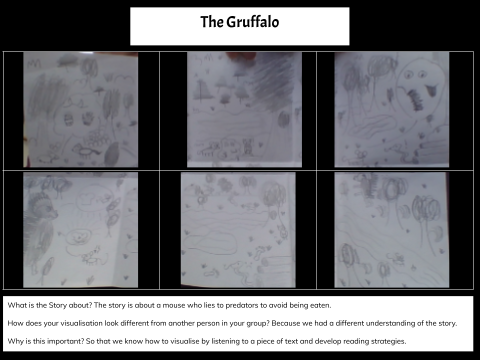


The Gruffalo story activity describes a certain part of the gruffalo story so that others are able to visualize and draw that part of the storyline using their understanding.
The Nogard activity describes features of an animal so that the audience is able to try visualize and draw what they understand of the description, to figure out which animal it is. A Nogard is dragon spelled backwards, so the activity was describing a dragon.
To visualize, readers sometimes start by reading or listening to a text or description, so that it gives them an idea of what kind of image to create in their head that follows the information they have been given.
Visualization is a helpful tool in reading so that others can create an image using the information in the text to understand what is happening. It encourages the audience to use creative thinking.
LI: to visualize parts of the story.


Maths | Statistical Investigation
Time is the ongoing sequence of events happening.
The median is found by organizing a range of numbers from least to greastest and finding the number in the middle. However, if there is more than one middle number, the two numbers are added and then divided by 2. For example: 2, 3, 4, 4, 5. The median is four.
The mean is found by adding a range of numbers together and dividing the total by how many numbers there were originally. For example: 4+6+5= 15. 15 divided by 3 is 5. The mean is five.
The mode is found by organizing a range of numbers from least to greatest and finding the most popular number (the number that appears the most). For example: 3, 4, 5, 5, 6. The mode is five because five appears the most in the number pattern.
The statistical investigation below shows that five people tested out measuring time by skipping. They measured how long it would take to skip 50 times, 5 times each. After they measured the length of their activity, they converted their times into a mean. They also found the median and mode for all times.
LI: to investigate units of time.
The median is found by organizing a range of numbers from least to greastest and finding the number in the middle. However, if there is more than one middle number, the two numbers are added and then divided by 2. For example: 2, 3, 4, 4, 5. The median is four.
The mean is found by adding a range of numbers together and dividing the total by how many numbers there were originally. For example: 4+6+5= 15. 15 divided by 3 is 5. The mean is five.
The mode is found by organizing a range of numbers from least to greatest and finding the most popular number (the number that appears the most). For example: 3, 4, 5, 5, 6. The mode is five because five appears the most in the number pattern.
The statistical investigation below shows that five people tested out measuring time by skipping. They measured how long it would take to skip 50 times, 5 times each. After they measured the length of their activity, they converted their times into a mean. They also found the median and mode for all times.
LI: to investigate units of time.
Subscribe to:
Posts (Atom)